Difference
Difference between BJT and FET

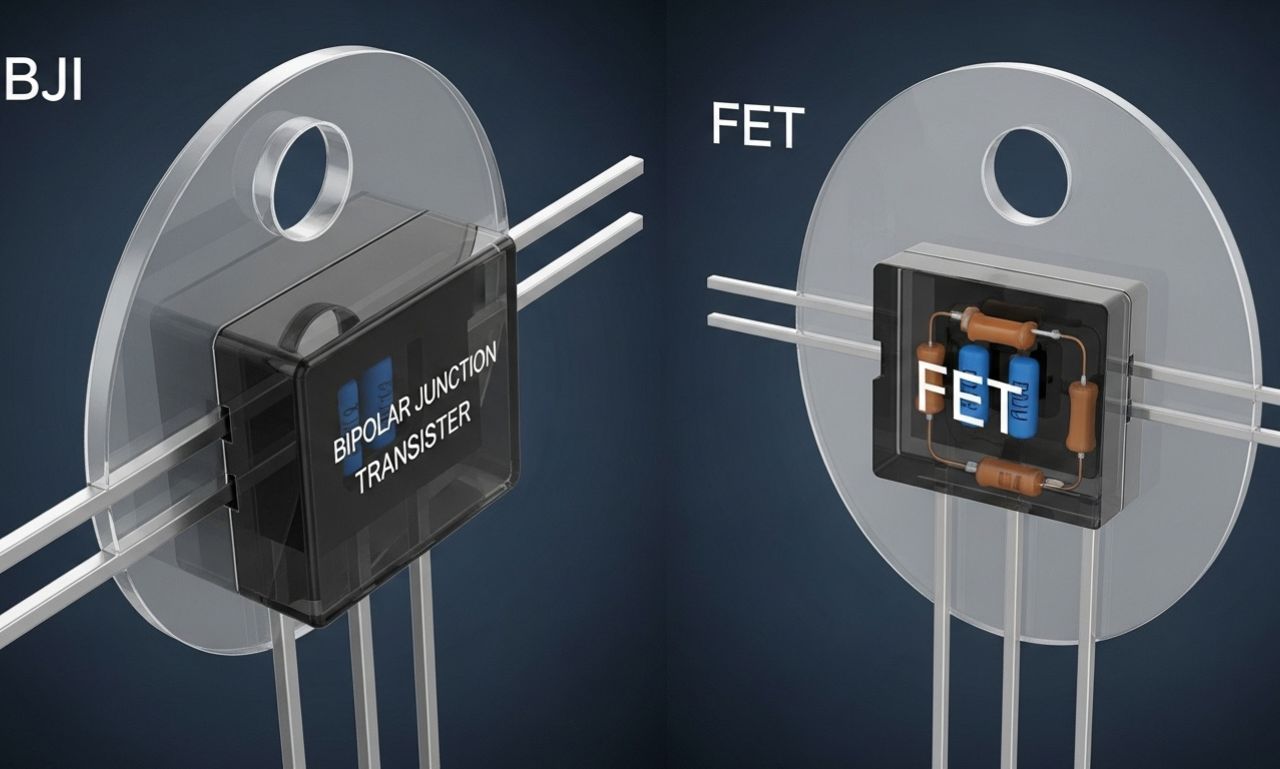
Difference between BJT and FET
byTheta Learning Point9:58:00 PM
In this article, we will explore the important differences between BJT (Bipolar JunctionTransistor) and FET (Field Effect Transistor). The main difference between BJT and FET is that BJT is a current-controlled device, while FET is a voltage-controlled device.
Before discussing the differences between BJT and FET, let’s first get an overview of their basics.
What is a Bipolar Junction Transistor (BJT)?
A bipolar junction transistor (BJT) is a three-terminal semiconductor switching device that consists of three semiconductor layers and two p-n junctions. BJT can perform switching and amplification of electronic signals.
BJT has three semiconductor regions namely, Emitter, Base, and Collector. The three terminals are formed by connecting three metallic conductors to each of these three regions. A bipolar junction transistor is a current-controlled device, i.e. its output is regulated by a current signal.
Based on the construction, there are two types of bipolar junction transistors namely, NPN transistor and PNP transistor.
Bipolar junction transistor is widely used in a variety of electronic devices for switching and signal amplification.
What is a Field Effect Transistor (FET)?
A field effect transistor (FET) is another type of transistor. It consists of a semiconductor channel and three terminals namely, source, gate, and drain. The current flows from the source to the drain. The voltage signal applied to the gate terminal controls the flow of current between the source and the drain.
Therefore, a field effect transistor is a type of voltage-controlled device. There are two types of field effect transistors namely, JFET (Junction Field Effect Transistor) and MOSFET (Metal Oxide Semiconductor Field Effect Transistor).
The major advantages of FETs include low power consumption, high input impedance, faster switching speed, simple biasing circuit, etc.
Therefore, FETs are very commonly used in several modern electronic devices and digital circuits.
After getting insights into the basics of BJT and FET individually, let us now study their comparison.
Difference between FET and BJT
The following table gives all the important differences between FET (Field Effect Transistor) and BJT (Bipolar Junction Transistor):
| Characteristic | BJT | FET |
| Full form | BJT is an acronym for Bipolar Junction Transistor. | FET is an acronym for Field Effect Transistor. |
| Control technology | BJT is a current-controlled device. | FET is a voltage-controlled device. |
| Terminals | BJT has three terminals namely, emitter, base, and collector. | FET has three terminals namely, source, gate, and drain. |
| Charge carries | In BJT, the current flows due to both majority and minority charge carriers. | In FET, the current flows due to majority charge carriers only. |
| Device types | BJT is a bipolar device, as the current flows due to both majority and minority charge carriers. | FET is a unipolar device, as the current flows due to only the majority charge carriers. |
| Input impedance | BJT has low input impedance. | FET has high input impedance. |
| Switching speed | BJT has a slower switching speed. | FET has a faster switching speed. |
| Fabrication as an IC | BJT is comparatively complex to fabricate as an integrated circuit. | FET is simpler to fabricate as an integrated circuit. |
| Gain bandwidth product | BJT has a higher gain bandwidth product. | FET has a lower gain bandwidth product. |
| Noise | BJT produces more noise. | FET produces less noise. |
| Types | BJTs are of two types namely, NPN transistors and PNP transistors. | FETs are of two types namely, N-channel FET and P-channel FET. |
| Voltage drop | BJT has a higher voltage drop. | FET has a lower voltage drop. |
| Immunity to radiation | BJT is less immune to radiation. | FET is more immune to radiation. |
| Thermal stability | BJT has less thermal stability. | FET has better thermal stability. |
| Size | BJT has a bigger size. | FET has a smaller size. |
| Energy efficiency | BJT is less energy efficient. | FET is highly energy efficient. |
| Configurations | BJT has three configurations namely common-base, common-emitter, and common-collector. | FET has three configurations namely, common-gate, common-source, and common-drain. |
| Input-output relation | BJT has linear input-output relation. | FET has non-linear input-output relation. |
| Applications | BJT is mainly used in low-power applications. It is used in switching, amplification, filter circuits, oscillators, etc. | FET is mainly used in high-power and high-frequency applications. It is widely used in integrated circuits, digital circuits, operational amplifiers, measuring devices, oscilloscopes, RF amplifiers, etc. |
Hence, this is all about the major differences between bipolar junction transistors (BJTs) and field effect transistors (FETs).

-

 Entertainment1 month ago
mkvmoviespoint: Your Ultimate Destination for Free Movies and TV Shows
-
 Blog1 month ago
هنتاوي Com: Revolutionizing Online Learning in the Arab World
-

 Business2 months ago
Unique New York-Inspired DIY Christmas Gift Ideas
-

 Education2 months ago
Why Discipline Matters: Understanding Its Importance in a Student’s Life
-

 Entertainment4 weeks ago
ibomma1.com: Your Gateway to the Latest Telugu Movies
-
 Entertainment1 month ago
Movierulz 2024: The Ultimate Guide to Streaming Movies Safely
-

 Technology2 months ago
How Generative AI Is Transforming Creative Industries
-

 Celebrity4 months ago
Isaac Avett: The Man Behind the Melodies – An In-Depth Interview